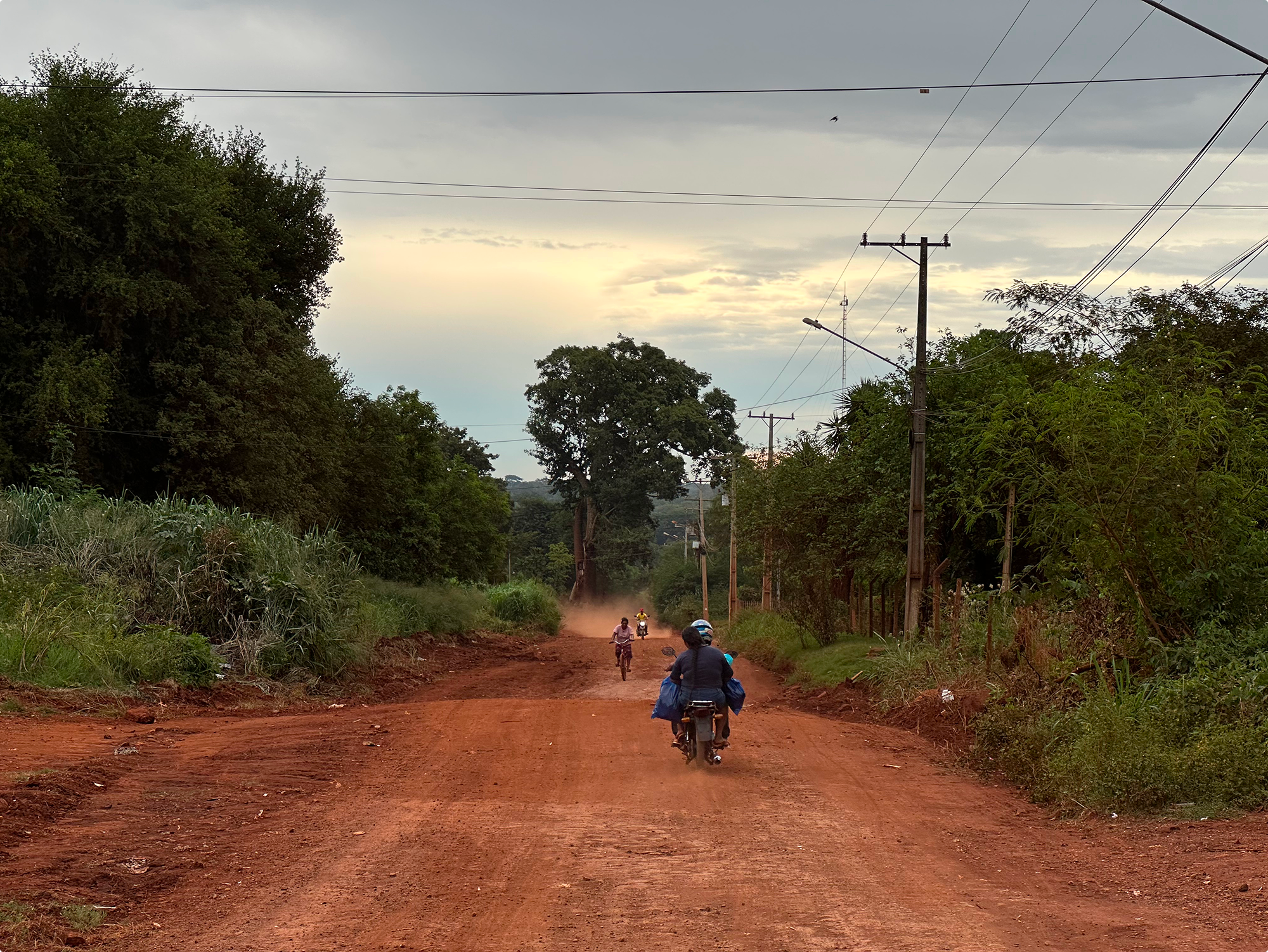
At the beginning of the last century, the Brazilian government decided to economically develop the country’s interior. This led to violent conflicts and the systematic displacement of the indigenous population. Traditional territories were destroyed by the expansion of agriculture and cattle farming, with devastating consequences for biodiversity, the protection of natural resources and the climate balance.
The government responded by creating reserves through the then Indian Protection Service (SPI), the first official government agency dedicated to indigenous affairs. Its aim was to protect and guarantee land rights; in practice, however, the policy aimed to assimilate indigenous peoples into agriculture and handicrafts within an externally imposed development model.
In 1917, National Decree 401 allocated a limited plot of land to the inhabitants of the Jaguapirú and Bororó villages. Since then, the area has been officially known as the Dourados Indigenous Reserve (RID). Its inhabitants, however, refer to it as the Jaguapirú-Bororó Village. In 1965, the area was finally legally recognised and is situated in the state of Mato Grosso do Sul.
Over the decades, the SPI’s humanitarian mission turned into its opposite: corruption, mismanagement and, in the 1960s, serious reports of human rights violations, forced labour and the spread of disease led to the agency’s dissolution in 1967, during the military dictatorship. Its successor was FUNAI (National Indigenous Peoples Foundation), which to this day is responsible for defending the rights and interests of the indigenous population in Brazil.
Life in a confined space
Today, more than 20,000 people live within the reserve’s 3,474 hectares – around 18 % of the state’s indigenous population, belonging mainly to the Guarani, Kaiowá and Terena peoples. Located near the city of Dourados, the village has become one of Brazil’s first and largest ‘urban’ indigenous reserves. The high population density within a limited area has placed a considerable overload on local natural resources and ecosystems, compromising the environmental balance, exacerbating social tensions and significantly weakening traditional community structures. The historical impacts of violence and oppressive policies faced by these populations over generations continue to profoundly shape daily life in the village and remain present to this day.
Socio-environmental situation
The situation in the Jaguapirú-Bororó indigenous village of is alarming:
- Suicides: suicide rates are among the highest in the world. According to a study by CDC and the Ministry of Health. These are estimated at 73 per 100,000 inhabitants per year – amongst young men aged 15 to 19, they reach 289 per 100,000. The organisation Survival International has documented a rate of 232 per 100,000 for the Guarani-Kaiowá people in the state of Mato Grosso do Sul.
- Environmental degradation: Historical deforestation, soil degradation, river siltation and the loss of biodiversity threaten food security and traditional ways of life. What was once a natural habitat for species is now largely ecologically degraded, with direct consequences for climate protection, as intact ecosystems are vital carbon sinks.
- Water shortage: The chronic shortage of drinking water leads to emergency water deliveries by tankers and imposes a humiliating dependence. Progressive climate change is exacerbating the problem – climate adaptation is not an abstract requirement here, but a matter of survival (source).
- Poor infrastructure: Inadequate sanitation facilities, a lack of sanitation systems and a lack of waste collection increase the risk of infectious diseases. More than two-thirds of households do not have a bathroom. More than half the population has no access to electricity.
- Poverty: More than 50 % of the population lives on less than a quarter of the minimum wage. According to the IBGE’s 2022 Census, 57.3 % of the economically active indigenous population in Brazil earns, at most, one minimum wage (source). The situation particularly affects women, who often have no income of their own and no decision-making power.
- Social vulnerability: Alcoholism, drug use and domestic violence are part of a daily life marked by a lack of perspective. Women and girls thus bear a double burden – as victims of violence and as the ones who uphold the family’s social structure.
What to do to ensure a decent future
- Promote access to education and employment, in order to open up perspectives that go beyond dependency.
- Eradicate precarious working conditions – such as sugarcane harvesting or meat processing – which hark back to patterns of colonial exploitation.
- Establish an effective system of basic sanitation, healthcare and social welfare.
- Protection against the growing pressure on land caused by agricultural and urban expansion – combined with systematic protection of resources.
- Promote gender equality and the empowerment of women as essential factors for a fairer society.Restore biodiversity and implement ecological agriculture, in order to reconcile food sovereignty with biodiversity conservation.
- Develop climate adaptation measures based on the community’s traditional knowledge
- Create integrated strategies for self-sustainable socio-environmental regeneration – in collaboration with the local population
The Jaguapirú-Bororó Village does not need alms. It needs partners who believe in a future where indigenous wisdom, climate protection and ecological responsibility go hand in hand.